How Many Players for Big Walk? (2–12, and What Actually Works)
By DayOneFix Editorial · August 6, 2026
The short version, straight from the official FAQ: Big Walk supports 2 to 12 players. There is no single-player mode. When asked about the ideal count, House House says any number in that range works — “we didn’t make the game with a specific number of players in mind.”
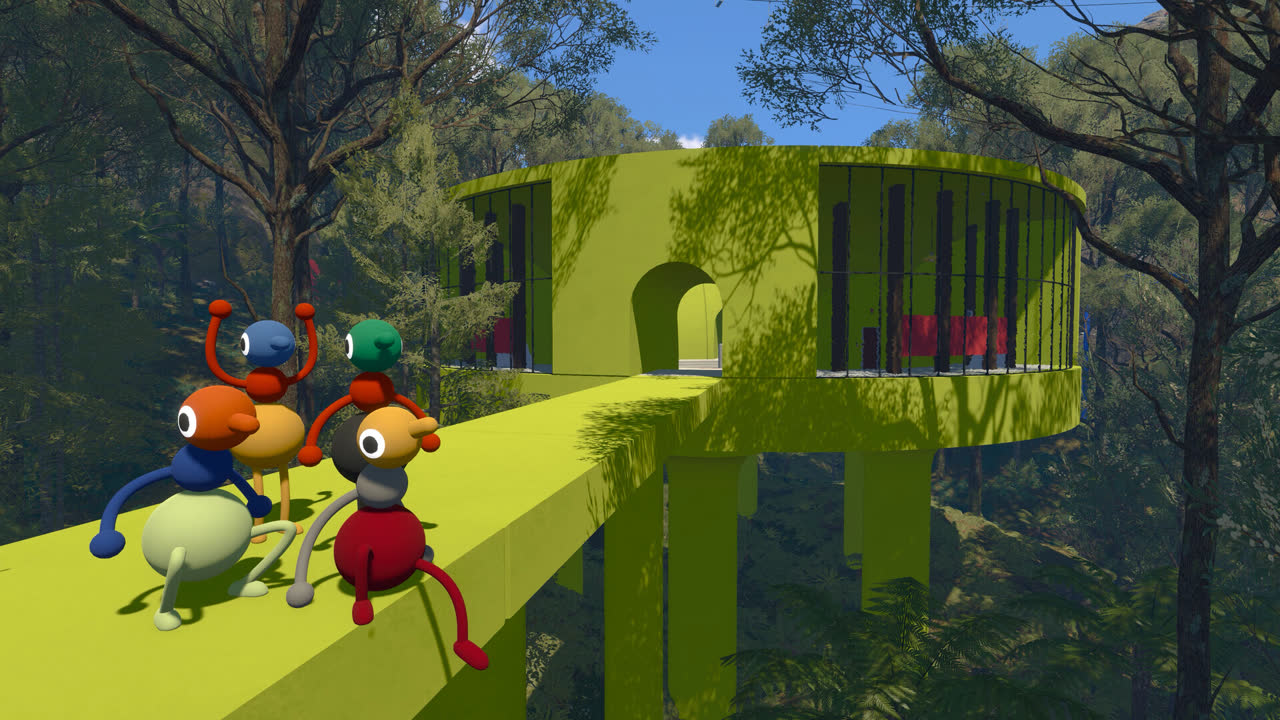
Here’s what those numbers mean in practice.
Can you play Big Walk solo?
No. The developers are direct about this: the game is “entirely about teamwork and talking.” Puzzles are built around information asymmetry — one player sees what another needs — so there’s no solo mode, and no workaround that makes one make sense. If you want the vibe with no friends online, the closest experiences are Peak with random matchmaking, or a co-op session with strangers via community Discords.
Does everyone need a microphone?
No — and this matters for group planning. The in-game text chat has full feature parity with voice chat per the official FAQ, including over walkie-talkies. A mixed group (some talking, some typing) works fine. What the developers do discourage is external voice tools like Discord, because distance-based communication is the core mechanic.
What group size actually plays best?
The official answer is “anything from 2 to 12,” but group size changes the texture of the game:
- 2–3 players — the intimate version. Every puzzle involves everyone; nothing gets skipped. Expect the longest playtime per session since you can’t parallelize.
- 4–6 players — the sweet spot most groups land on. Enough people to split into pairs for multi-part puzzles, small enough that everyone stays involved and the voice channel stays readable.
- 8–12 players — the party version. Reviewers note that bigger groups can split up and tackle puzzles simultaneously, which meaningfully shortens the campaign — at the cost of some players missing puzzles entirely. Also the funniest configuration, if that’s the goal.
There’s no wrong answer, but if you’re organizing a first playthrough: aim for 4–6, use in-game comms only, and plan around 8-ish hours for the main campaign.
The setting people misread: the host picks a version of the world
This is the part that trips up groups, and it isn’t obvious in game. Each time the host starts a session they choose a 2-player, 3-player or 4+ player version of the world, and some things in the world change to adapt to that choice.
Two consequences worth getting right before your first session:
- It is a minimum, not a maximum. The setting only configures how challenges are laid out — it does not cap how many people can join. Picking “3 player” doesn’t stop a fourth from walking in.
- Pick for who will definitely be there the whole time. If two people are joining for an hour and then leaving, the official advice is to choose the lower number rather than the headcount you started with. A world configured for a group that then shrinks plays worse than one configured for the core.
There is no matchmaking, and that’s deliberate
You cannot be matched with strangers. House House’s reasoning: Big Walk is a long-form cooperative game meant to be played by the same group across multiple sessions, so throwing random people together doesn’t fit it. Plan on organising a group you know — there is no queue to fall back on.
Joining, hosting, and saves
- Progress is saved automatically by the host — choose a host who’ll attend every session, because the campaign lives with them. Return sessions need that same person to host, or you’ll load someone else’s save. If a save “disappeared”, this is almost always why: black screen and missing saves.
- When the host stops the session, everyone is disconnected — so host stability matters more than group size.
- Joining is by platform friends list or a Join Code that regenerates every session. Anyone with the code can join, as can friends of anyone already in — set a password from Session Details if you’re streaming.
- Crossplay is supported across PC/Mac, PS5, and Switch 2, so group size isn’t limited by platform — details in the crossplay & platforms guide.
FAQ
How many players does Big Walk support? 2 to 12 players, per the official FAQ. There is no single-player mode, and House House says any number in that range works — the game wasn’t made with a specific player count in mind.
Can you play Big Walk solo? No. The game is “entirely about teamwork and talking,” with puzzles built around one player seeing what another needs — so there’s no solo mode and no workaround that makes one make sense.
What’s the best group size for Big Walk? Officially, anything from 2 to 12. In practice, 4–6 is the sweet spot most groups land on: enough people to split into pairs for multi-part puzzles, small enough that everyone stays involved.
Does everyone need a microphone? No. The in-game text chat has full feature parity with voice chat per the official FAQ, including over walkie-talkies, so a mixed group of talkers and typers works fine.
Does Big Walk have matchmaking with strangers? No, and that’s deliberate — it’s a long-form cooperative game meant to be played by the same group across multiple sessions, so there is no queue to fall back on.
Related
- How long Big Walk takes to beat
- Split screen and local co-op: the real answer
- Crossplay and platforms
- Big Walk guide hub
More questions? The Big Walk guide hub covers everything else groups run into.
Sources
The 2–12 cap, the absence of a solo mode, House House’s answer about a “best” group size (it had no particular number in mind while making the game), the “entirely about teamwork and conversation” framing, text chat’s feature parity with voice including the walkie-talkie, the advice against external voice apps, host-side autosaving, everyone dropping when the host ends a session, the per-session Join Code and Session Details password, the deliberate absence of stranger matchmaking, and the host’s choice of a 2-, 3- or 4-plus-player world version (a floor rather than a cap, chosen by how many people will be there throughout) are all the developers’ own words in the official Big Walk FAQ. The point that a big group splitting up to work several puzzles at once measurably shortens the campaign comes from Insider Gaming’s full-length report. The texture we ascribe to 2–3, 4–6 and 8–12 player groups, and the suggestion to aim for 4–6 on a first run, are our editorial reading of those mechanics — House House has never divided the player range up that way.