We Were Here Tomorrow laser puzzle: split the jobs before you move another crystal
By DayOneFix Editorial · October 23, 2026
Work through these
0 / 5 doneTicks are saved on this device — close the page and pick up where you left off.
Two people saying “that one over there” creates a third puzzle nobody asked for. In Optics Lab, seeing your partner does not mean sharing their information. The useful split is reader and operator, not two people turning everything at once.
This page covers crystal identification and a repeatable co-op checking method for the laser puzzle. It is not a full-game walkthrough or an independently tested, universal holder-by-holder solution. We reviewed selected frames in publicly credited gameplay, not a DayOneFix play session.
Are you in the right room?
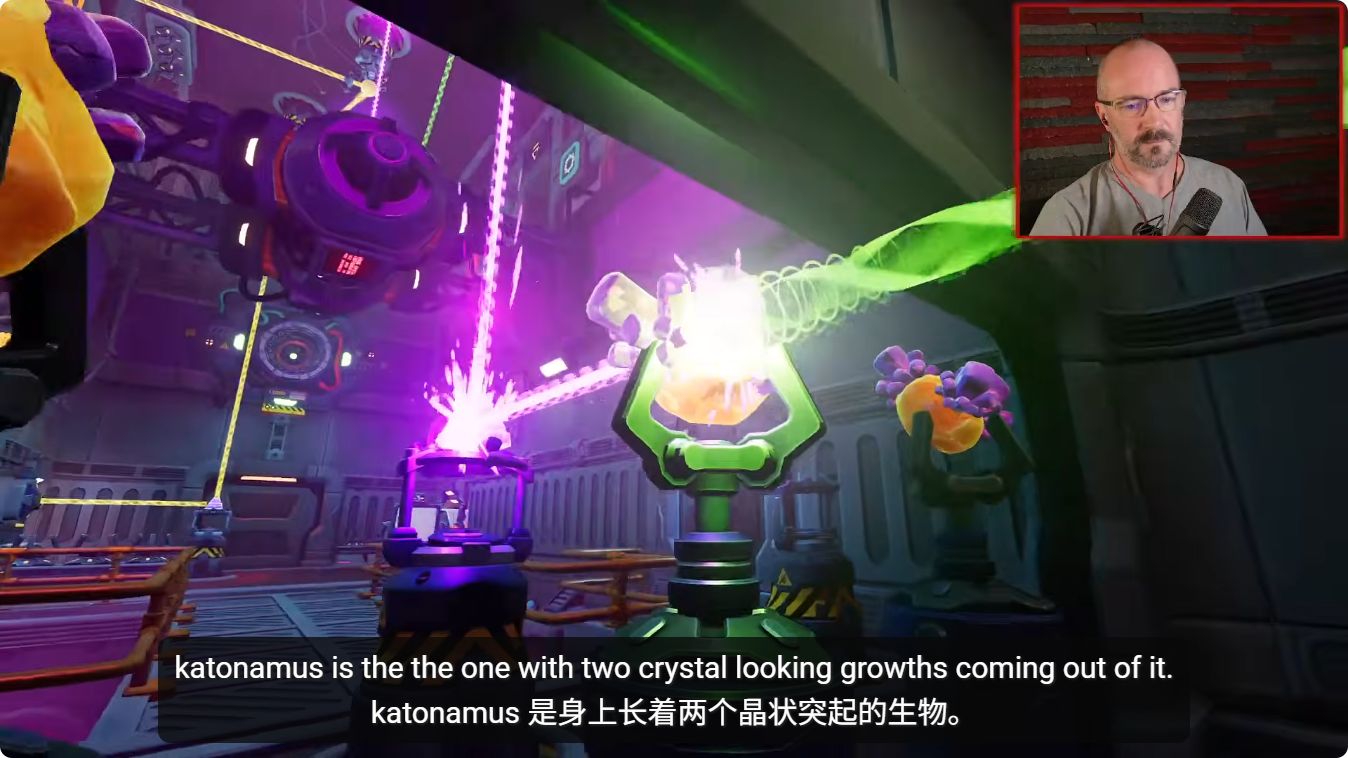
The creative director’s developer article identifies Optics Lab as a room where the explorers can see one another but have different information needed for laser refractions.
Look for the laser apparatus, crystal holders and research notes. If your problem is a generator, numbered control modules or three batteries, stop here: a laser ordering hint is not a cable-puzzle route.
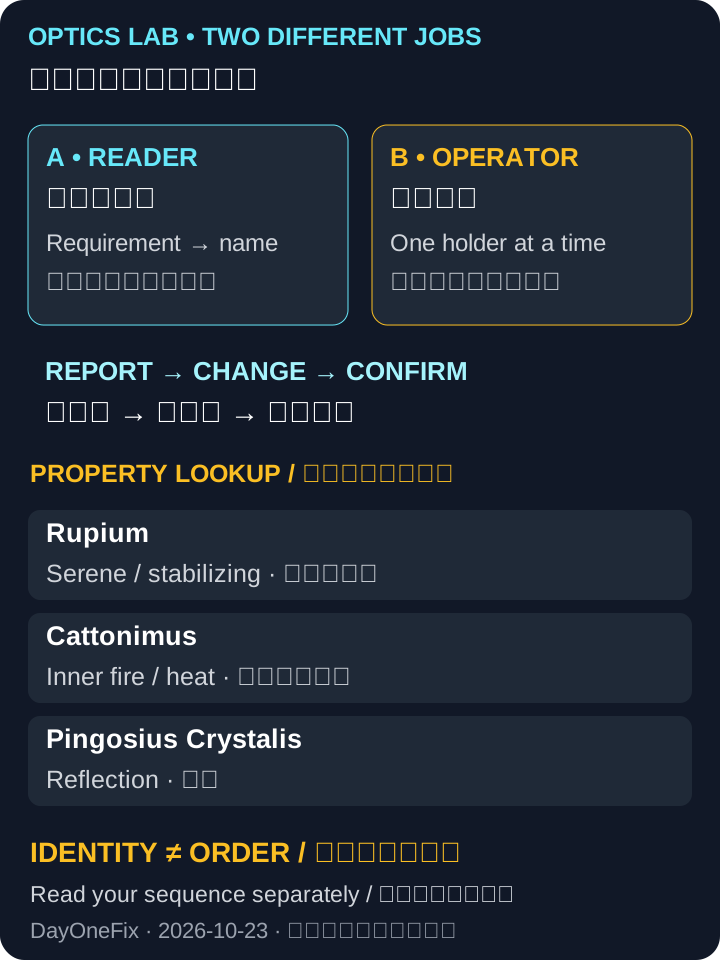
Agree on two jobs, not two permanent character classes
| Current job | Do this | Useful callout |
|---|---|---|
| Reader: whoever can inspect the needed note or drawing | Give the instruction and identifying features before anyone moves a piece | “The clue means stabilizing; the board associates that with Rupium.” |
| Operator: whoever can access the relevant holder/control | State the landmark and proposed change; change only that part | “Holder beside the framed doorway. I am changing this holder only.” |
| Both | Confirm what changed before the next move | “The beam left this room; where does it arrive on your side?” |
These are our coordination roles, not fixed names for the game’s two characters. Switch the jobs when access or information switches.
“Left” is a poor shared address when you face each other from different sides. Use a visible landmark plus the current holder instead. Before a reset, agree what each person is about to change; a useful observation is easily lost if both edits happen together.
Hint 1: we can see each other—why do we still need to talk?
Visibility is not access to the same clues. Start by describing your instruction and the other player's available controls. A useful report names the object and what changed, not merely “it doesn't work.”
Translate the board before treating it as an answer
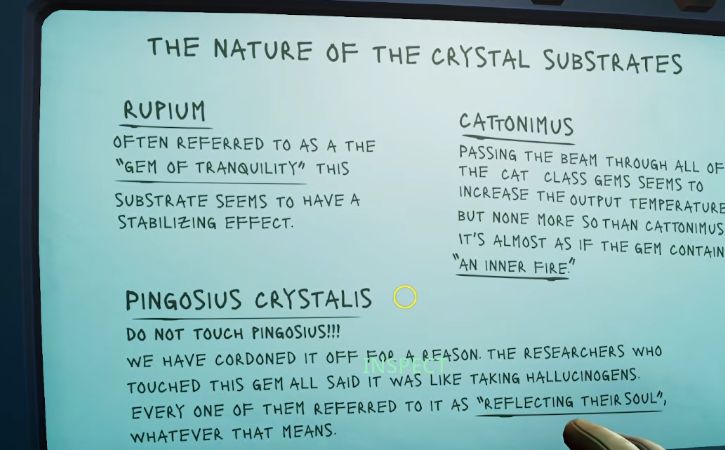
The readable board supplies this lookup:
| Clue meaning | Name on the board | What the reviewed text establishes |
|---|---|---|
| Tranquility / stabilizing | Rupium | The note connects this crystal to a stabilizing effect |
| Inner fire / strongest heat among the cat-class gems | Cattonimus | Its entry associates it with heat and inner fire |
| Reflection / mirror-like clue | Pingosius Crystalis | The researchers’ reflection description is the relevant association |
Use the exact name and the drawings available in your session together. A matching colour alone is not a reliable name tag.
Keep identification and ordering separate. Knowing what “serene” refers to does not establish whether it goes first, second or last. Read the instruction that gives your current sequence, then apply the lookup. Do not invent a missing instruction from the list’s printed order.
Hint 2: how do we turn the prose into something actionable?
Have one player report the required clue sequence, while the other translates each clue into a crystal name using the board. Repeat the named sequence back before aiming the beam. If a drawing has a look-alike, compare its visible features rather than selecting by colour alone.
Worked example—not a universal answer: what if our instruction says mirror → serene → inner fire?
The lookup yields Pingosius Crystalis → Rupium → Cattonimus. This is a conditional example based on the displayed meanings, not a claim that every session or future patch uses that wording or the same physical holder positions. If your instruction differs, translate that instruction instead.
Trace one change, then compare both views
- Name the required crystal sequence from your instruction.
- Start from the visible emitter and identify the next actual connection.
- The operator names the holder and what is being changed; the reader watches the expected consequence.
- Record each special crystal the beam passes through, in order. If the same name appears again, check that against the instruction instead of ignoring the extra visit.
- At the apparatus, compare the recorded chain with the required chain. Look for the game’s success feedback before declaring the room solved.
This is a checking method, not a claim that we validated every holder angle. We do not supply unobserved mirror coordinates, assume both players can rotate the same object, or label a control as broken because one player cannot operate it.
Download the blank beam-routing log. It has no prefilled successful route, no account fields and no upload step. Fill a row after a real change rather than after both players have moved several things.
If you are stuck, first name the kind of failure
| What you observe | Check next |
|---|---|
| The beam stops before the next connection | Inspect the last physical change before rewriting the clue translation |
| The beam arrives but the configuration is rejected | Compare the actual crystal identities and order with your instruction |
| One player cannot operate this holder | Check which side has access and which control is available; do not infer a softlock from that alone |
| Nothing has changed after several attempts | Keep one setting fixed and change one other setting; preserve the observations in the log |
| You are actually at a numbered generator panel | Use a generator-specific guide; this page does not verify that puzzle’s module order |
Evidence and limits: reviewed on 23 October 2026. The developer article establishes the asymmetric-information design; Tango Tek2’s selected gameplay frames establish the displayed crystal descriptions and illustrated room. A second player’s view of the same co-op session is not an independent reproduction. We have not verified a universal fixed solution, every reset condition or softlock recovery. No claim here requires buying another copy, deleting saves or installing a third-party tool.
Next: recent single-problem game guides. For a different kind of “I looked everywhere,” see our Mothling missing-boots route.